Grader Guarantees Cover Mistakes, Not Fakes
In August 2025, a 1961-62 Fleer Wilt Chamberlain rookie graded PSA 10 sold at Heritage Auctions for $976,000. According to cllct, the winning bidder was uneasy with the 10 and sent it back to PSA for a guarantee review. PSA regraded it a 9. cllct put the drop in market value at about $800,000. PSA said the owner "was compensated for the difference in value under the terms of the PSA Grade Guarantee," but did not say how much. Those terms, as cllct noted, cap any single claim at $250,000.
That one claim is a useful way into what this article explores: how and when collectors are, and are not, protected by grader guarantees. In the Wilt case, the guarantee worked: PSA found its own grade was wrong and paid the owner. But it paid on PSA's terms, not the market's. PSA decides what the card is worth at each grade, and a written cap limits what any owner can recover, no matter what the card sold for.
What The Guarantee Is For
A grader sells an opinion sealed in plastic: this card is authentic, and this is its condition. The guarantee is the grader's written promise about what happens if that opinion turns out to be wrong. It is the main document standing behind the number on the label, and most buyers never read it. Many assume it protects them whenever a slab turns out to be bad.
It does not. Read closely, a grader's guarantee covers the grader's own mistakes, on the grader's terms. It does not cover fraud by someone else.
We compared the current terms of the 4 major card graders, side by side, and set them against the documented cases.
Mistake Or Fake: Grader Error Vs. Fraud
When a slab turns out to be wrong, it is usually 1 of 2 things.
Grader error. A genuine slab holds a card the grader got wrong: overgraded, or trimmed, recolored or otherwise altered in a way the grader missed. This is what a guarantee is built for, though not completely. PSA's terms, for example, say its "Authentic" and "Authentic Altered" labels are interchangeable and "not subject to compensation," because the word "Altered" is not always printed.
Fraud. The holder or label is the problem: a fake case, a forged label, a real label moved into a resealed case, or a real cert number copied onto a fake. In January 2026, a federal jury in Manhattan convicted Anthony Curcio of wire fraud; according to the US Attorney's Office, he cleaned the grades and serial numbers off real PSA labels and printed fake 9s and 10s, focusing on vintage Jordan rookies. His co-defendant pleaded guilty. In a separate case in the Eastern District of New York, an 84-year-old Colorado man, Mayo McNeil, pleaded guilty in a scheme that, according to court documents, included fake PSA holders; 1 victim told Sports Collectors Daily the cards he bought were real, just not the ones PSA had graded.
The scale is not small. PSA's 2025 fraud report, as summarized by SI, said the company intercepted more than $200 million in counterfeit and altered collectibles before they reached a holder, and listed counterfeit slabs among the methods it is seeing.
The buyer sees the same thing either way: a slab that is not what its label says. The written guarantees treat the 2 completely differently.
What The Guarantees Say
Here is how the 4 major card graders compare, based on their terms as of November 19, 2026 (see the note at the end).
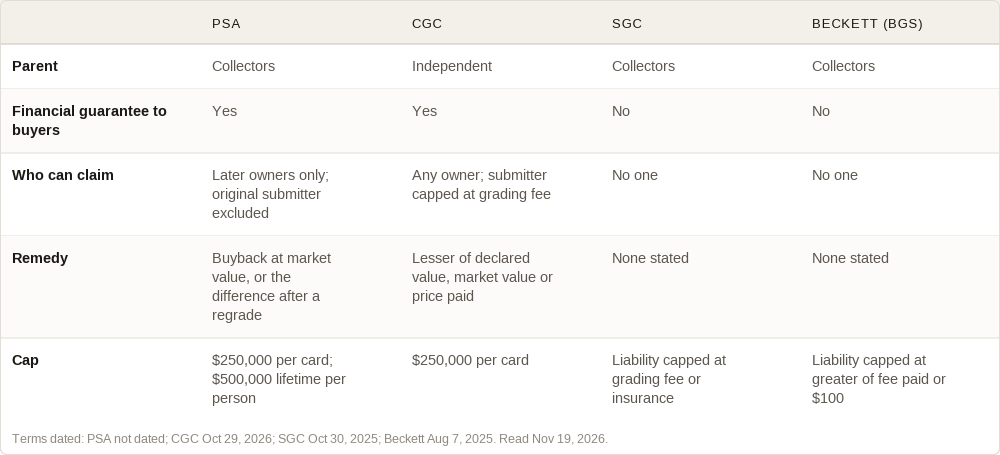
Full terms: PSA, CGC, SGC and Beckett.
For Collectors
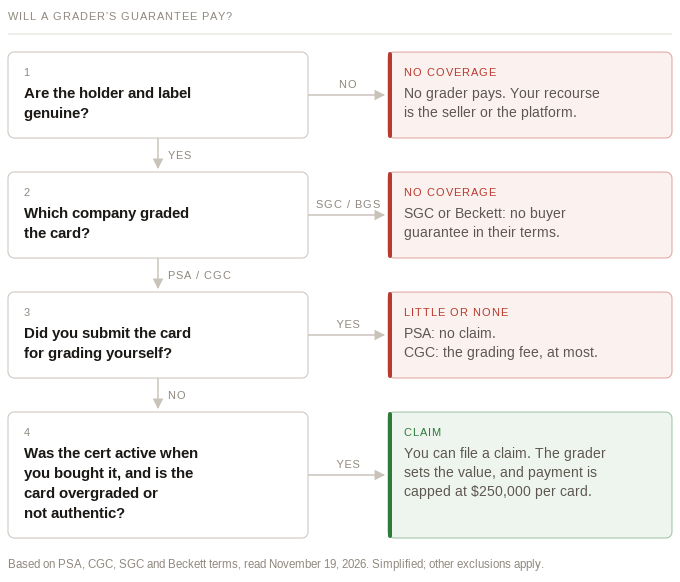
What the written terms mean for the slabs you buy and own.
Where You're Not Covered
Beyond what the flowchart shows, the written terms leave these gaps.
- The grader sets the price. PSA values claims in its "sole and absolute discretion." CGC pays the lowest of 3 numbers, including what you paid. Both cap a single card at $250,000, no matter what the card sold for.
- An altered label may not count as an error. Under PSA's terms, a card later found altered, in a holder that says only "Authentic," is not compensated for the difference.
- Deactivation timing decides coverage, and nobody publishes the procedure. PSA excludes cards whose cert was deactivated before the most recent purchase. CGC covers only certs with no published warning at the time of purchase. SGC can deactivate at any time. None of the 4 publishes a step-by-step account of what happens to the slab and its owner after decertification.
- The process itself is a cost. PSA claims require an attestation, may involve a background check and carry a $25 fee if denied. CGC requires proof the owner tried to unwind the sale first. Beckett requires arbitration in Texas within 12 months.
What To Check Before You Buy
Because no grader's guarantee covers a counterfeit slab, the checks a buyer runs before paying, and the return policy of the seller and platform, are the real protection.
- Look up the cert, but treat a match as the minimum, not proof. A cert number is public information; anyone can read it off a photo or the grader's database and print it on another label. Compare the card itself, the grade and any stored images against the slab in hand. A cert that reads as deactivated is a stop sign under PSA's and CGC's terms.
- Check whether the cert was active on your purchase date. PSA's guarantee depends on it. Screenshot the lookup at purchase.
- Know which grader's label you are buying. A PSA or CGC slab carries a written buyback promise for later owners; SGC and BGS slabs do not, even though they share PSA's parent company.
- Use eBay's Authenticity Guarantee where it applies. eBay's help page lists eligible graded cards at $200 and up from PSA, Beckett, CGC and SGC; its program page still lists $250. PSA inspects the holder and label for tampering, not the card's grade, and items that fail are refunded.
- Buy from sellers who accept returns. Under eBay's terms, if the seller does not accept returns, the sale is final once authenticated.
- Keep proof of purchase. Both PSA and CGC require it to value a claim.
Note on the table: Beckett promises "the finest, most thorough, consistent and accurate authentication efforts," a pledge of effort rather than a financial remedy, and a no-agency clause gives later buyers no rights under its terms. SGC reserves the right to deactivate a cert, or remove a card from its holder, at any time if it believes the card is altered, counterfeit or tampered with. CGC's review is free to file, but the owner must first try to unwind the sale.
The author grades cards and buys and sells graded and raw cards.
Latest from the Calculus
All of the Calculus →One Cert, Two Slabs: What A $288,000 Dragonite Shows About Cert Lookups
November 27, 2026Cards Fall Further Into Correction, Giving Back a Third of 2026’s Gains
November 23, 2026
Rookie running backs Emmett Johnson and Jonah Coleman reach the top 10; Lendeborg leads at 100°
November 22, 2026