One Cert, Two Slabs: What A $288,000 Dragonite Shows About Cert Lookups
On October 23, a 2002 Pokémon Expedition Holo Dragonite graded PSA 10 hammered at $288,000, with buyer's premium, in Fanatics Collect's October Premier Auction. The listing said the card's certification number, 65821932, had been checked against PSA's database and was active as of October 14.
Five days later, a collector posted on Reddit that the cert belongs to a slab in his own collection. He said he submitted the card to PSA himself, has kept it since, and owns the card in every grade from PSA 1 to PSA 10. He said the card in the Fanatics listing is not his: the holo pattern is different, and the label lettering is laid out differently from every slab in his set. The same day, Fanatics Collect CEO Nick Bell replied on X: "We are looking into this now."
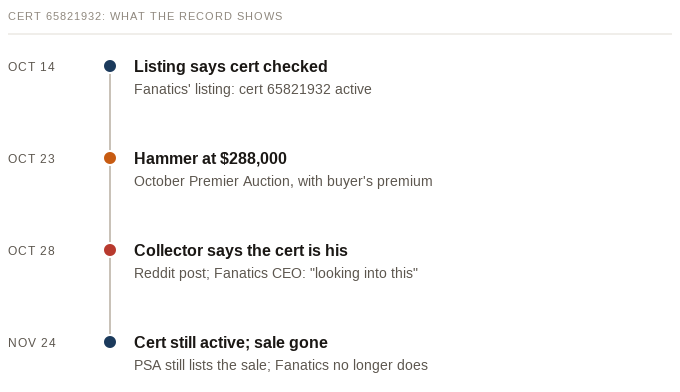
Nearly 4 weeks later, PSA's cert page still shows an active GEM MT 10 Dragonite, now with front and back images that collectors said were missing in October, in a PSA Set Registry set under the same name as the collector's Reddit account. Its sales list still includes the $288,000 sale. Fanatics Collect's sales history no longer does; the company says it removes sales that go unpaid, but has not said why this one was removed. Neither company has said publicly what it found.
Nothing public settles which slab is genuine. That is the problem this piece is about.
The 2 examples here are Pokémon cards, because they are the clearest current cases. Nothing about them is specific to Pokémon. Any graded card has a cert number, and every cert number is public.
The Rayquaza
The second case has a finding. In November, a collector in British Columbia told CTV News he paid US$660,000, in cryptocurrency, through a Pokémon card broker for a 2011 Call of Legends Shiny Rayquaza graded PSA 10. After it arrived, he noticed problems with the label. According to CTV, PSA determined the slab was not an authentic PSA 10, though the card inside was believed to be real, and emails CTV obtained show PSA working with law enforcement.
What The Guarantee Says About Both
Our look at grader guarantees found that they cover the grader's own mistakes, not fraud by someone else. Run these 2 cases through PSA's written terms and the result is the same for everyone involved.
- The collector who says the cert is his is the original submitter. PSA's guarantee does not apply to the original submitter of a card.
- Any buyer of a counterfeit holder is excluded. PSA's terms do not cover items with tampered or counterfeit holders or labels "regardless of certification status," which means even when the cert number on the fake label is real and active.
- The Rayquaza buyer is in that second group. His recourse is the seller, not the grader.
If the second Dragonite slab proves counterfeit, then neither the owner whose cert was copied nor the person who bought the copy has a guarantee claim as PSA's terms are written.
What A Cert Lookup Can And Can't Tell You
A cert lookup answers one question: does this number exist, and what did the grader record for it? It does not answer the question a buyer actually has, which is whether the slab in hand is the one the grader made.
- Cert numbers are public. They show up in every photo of a slab, in auction listings and in the grader's own database. The Dragonite collector had posted photos of his slab, cert visible, years earlier. A forger needs only a number that already passes a lookup.
- "Active" is not proof. The Dragonite cert is still active after a second slab surfaced carrying it.
- Older certs may have nothing to compare against. Many older PSA certs have no card images on PSA's site. Collectors in October noted that this one had none; it has images now.
What helps, in order:
- Get detailed images before you buy: front and back, close-ups of the label, and the edges of the holder. When the slab arrives, check it against those images.
- Compare against what's known. Check the card against the grader's stored images, when it has them, down to the holo pattern and centering. Check the label and holder against a genuine slab from the same period. The Dragonite collector spotted the problem because the label lettering was laid out differently from every slab in his own set.
- Don't treat a venue's cert check as a holder check. The Dragonite listing said the cert had been checked and was active. That confirms the number, not the slab.
- Ask for provenance on high-value slabs. Where was it bought, and when? A slab with a documented history is harder to fake than a number.
What The Record Doesn't Answer
Two questions remain open, and only the companies involved can answer them. How does PSA decide which of 2 slabs carrying one cert is genuine, and does it tell both owners? And what did the review Fanatics Collect's CEO announced on October 28 conclude?
The author grades cards and buys and sells graded and raw cards.
Latest from the Calculus
All of the Calculus →
Grader Guarantees Cover Mistakes, Not Fakes
November 25, 2026Cards Fall Further Into Correction, Giving Back a Third of 2026’s Gains
November 23, 2026
Rookie running backs Emmett Johnson and Jonah Coleman reach the top 10; Lendeborg leads at 100°
November 22, 2026