How Card Ladder Values a Card
Card Ladder uses three methods depending on the card. Knowing which one applies tells you how much to trust the number.
A Card Ladder value is almost always one sale: the card's most recent sale, moved up or down by how that player's whole card market has moved since. What changes from card to card is which sale counts and when the index adjustment applies, and that depends on whether the card is on Card Ladder's verified Ladder (the green check) or not.
The Short Version
A. CL Value (cards with Card Ladder's green check): the last sale, adjusted by the change in the player's index since that sale. These values always move with the index.
B. Estimated Value (cards without a check): the newest sale that survives an outlier filter. If it is less than two weeks old, it is the value; if it is older, it moves with the index.
C. Grade Ratio Value (no sale in more than a year): an estimate built from a recent sale of another grade of the same card.
A. CL Value: Cards with the Green Check
Card Ladder's research team verifies a selected set of cards and reviews every sale of them. It starts with the players who have the most collectors and, for each, adds the main base rookie card in the most-wanted grades, then that card's main parallel, then the rookie patch auto. A green check on a sale in Card Ladder's sales history means the team verified it.
For these cards, the CL Value is the card's last sold price (the average of its sales on the most recent day it sold) multiplied by the change in the player's index since that day. If the player's index is up 5% since the card last sold, the CL Value is 5% above that sale.
The confidence bar. Directly under every CL Value is a row of five short bars: Card Ladder's confidence level. The more bars lit, the more recent the sale behind the value.
- 5 bars: the last sale was less than two weeks ago
- 4 bars: two weeks to a month ago
- 3 bars: one to three months ago
- 2 bars: three to six months ago
- 1 bar: more than six months ago
The dollar figure looks the same either way, so the bar is the quickest way to tell a recent sale from an old one stretched by the index.
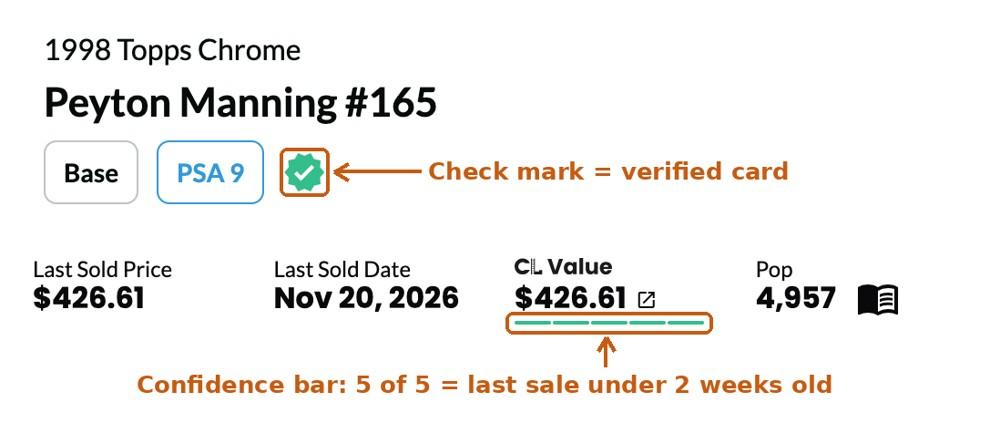
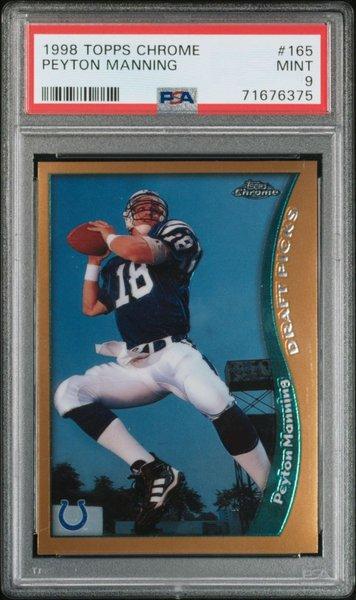
- Card: 1998 Topps Chrome Peyton Manning #165, PSA 9, on the Ladder
- CL Value on Nov 21, 2026: $427, the same as its Nov 20 sale
- Last three months: 85 sales from $350 to $624, averaging $497
The value fell $41 in one day because a new day's sale replaced the previous one. For a card that sells this often, the CL Value is simply the latest sale, and the latest sale can land anywhere in a wide range.
B. Estimated Value: Cards without a Check
Most cards aren't on the Ladder. For graded cards matched from Card Ladder's database of more than 80 million sales, the site shows an Estimated Value instead. On the card's page there is no green check, the value is labeled "Estimated Value," and a "Graded Card Automatic" tag sits below it.
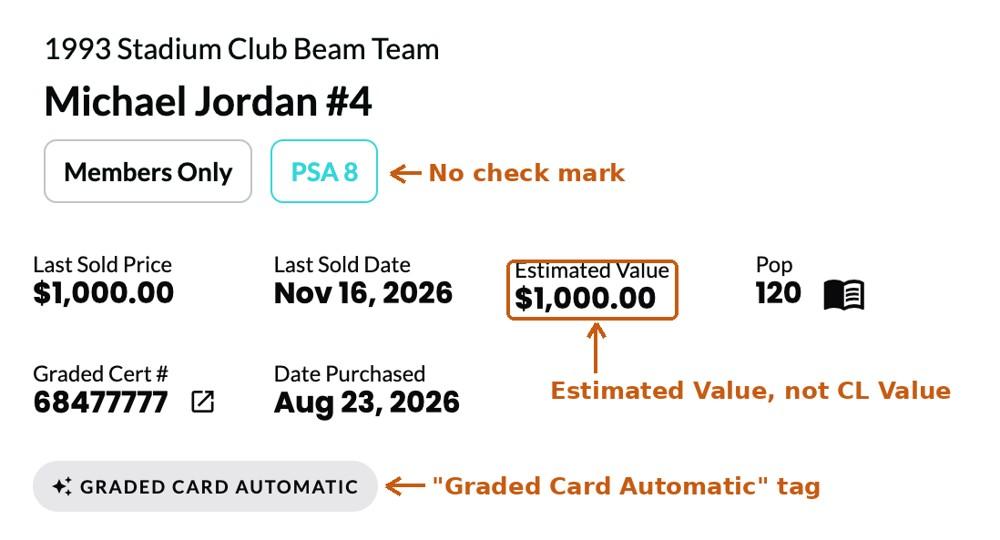
Card Ladder published the method in July 2026:
- Take the sales of the exact card, grade and grading company, up to 1,000, leaving out sellers Card Ladder has flagged.
- Keep the last six months of sales, or the last three months if there were more than 10.
- If more than three sales remain, keep the newest 25 and drop unusually high or low prices with a standard statistical test (the interquartile range rule).
- The newest sale left is the one that counts.
- If that sale is less than two weeks old, it is the value. If it is older, it is adjusted by the player's index since the sale; with no player index, Card Ladder uses a category index such as Pokémon, or its CL50 index. If the index has no data within 60 days of the sale or of today, no value is shown.
In Card Ladder's own example, a 1998 Stadium Club Peyton Manning PSA 10 had 11 sales in three months. The filter removed a $245 sale and a $200 sale, and the newest remaining sale, $125 the day before, became the value.
A Sale More Than Two Weeks Old Moves with the Index
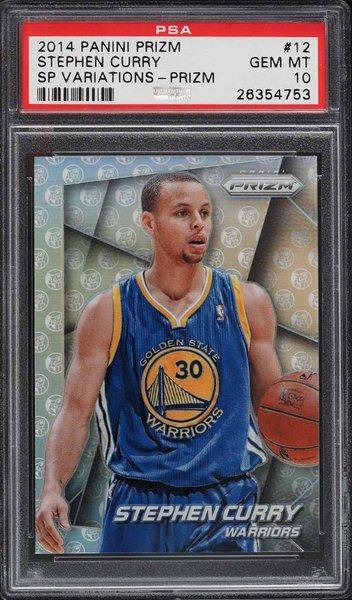
- Card: 2014 Panini Prizm SP Variations Stephen Curry #12, PSA 10
- Last sale: $1,320 on Nov 5, 2026, an accepted eBay Best Offer
- Estimated Value on Nov 21: $1,350
- Earlier sales: $1,230 to $1,470 since Sept. 20
By Nov 21 the last sale was more than two weeks old, so the Curry index moved it, about 2% higher, and the value rose another $30 that day. Card Ladder doesn't show the index figures it used, so the exact math can't be checked from the page. One useful detail: Card Ladder records the accepted price on eBay Best Offer sales, which eBay itself doesn't display.
One Sale Can Cut the Value in Half
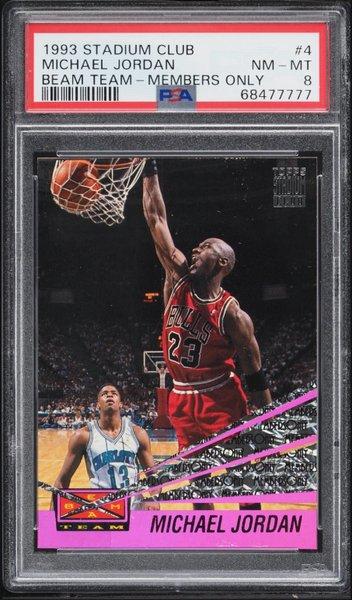
- Card: 1993 Stadium Club Beam Team Members Only Michael Jordan #4, PSA 8
- Estimated Value on Nov 21, 2026: $1,000, from a single eBay auction on Nov 16
- Sales before it: $1,980 twice in late August, $1,442 and $1,300 in July
With only a handful of sales, the outlier filter has little to compare against, so the newest sale sets the value even when it sits well below everything before it. The title of the $1,000 listing also leaves out "Members Only," the version this card is. If that sale was the regular Beam Team card, the value rests on a different card. Either way, this Estimated Value describes one auction more than where the card trades.
C. Grade Ratio Value: Cards That Haven't Sold in a Year
When a card hasn't sold in more than a year, Card Ladder can estimate it from another grade of the same card. It looks for a grade that sold in the last six months and that once sold within six months of a sale of your grade, works out the price ratio between the two at that time, and applies it to the other grade's latest sale. If a BGS 9.5 copy last sold for $2,000 and PSA 10 copies used to sell for twice as much, the PSA 10's Grade Ratio Value is $4,000. When several grades qualify, Card Ladder uses the highest.
Example: When the Two Numbers Disagree
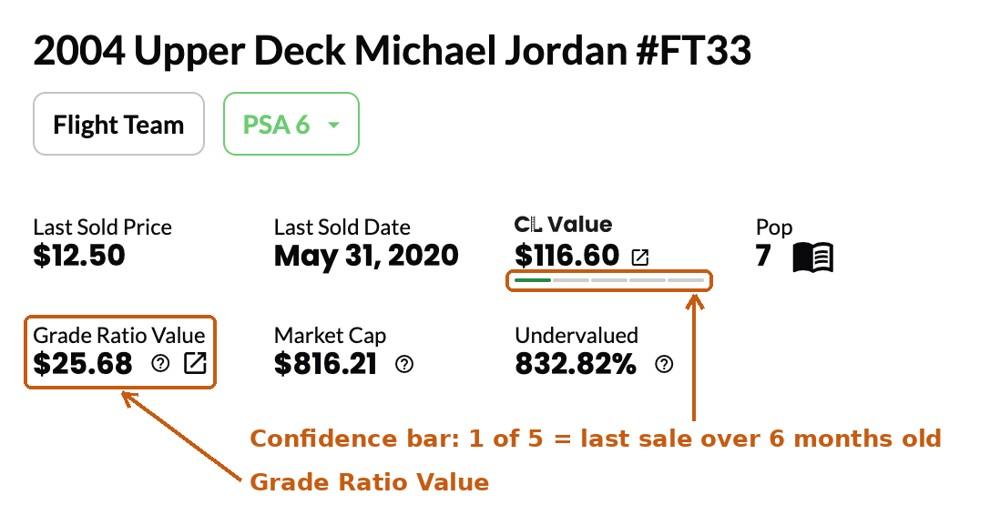
This 2004 Upper Deck Flight Team Michael Jordan PSA 6 last sold for $13 in May 2020. Six years of gains in the Jordan index have carried its CL Value to $117, with only one of the five confidence bars lit, and above the $78 CL Value of the same card in PSA 7, which last sold for $21. Its Grade Ratio Value, built from a recent sale of another grade, is $26. That is the problem Grade Ratio Value exists to fix: Card Ladder says it added it after seeing lower grades valued above higher ones when the last sale was old.
Card Ladder notes that these ratios drift, and that the gap between higher and lower grades tends to widen when the market rises. Our Grader Premium Index tracks how far apart grades and grading companies sell each month; see PSA vs BGS vs SGC vs CGC for the current figures.
How the Player Index Works
A player's index adds up the last sold value of every card of that player Card Ladder tracks and divides by the number of cards. Like a stock index, it uses a divisor that adjusts when a card sells for the first time, so a new card entering the index doesn't make it jump. Each index starts at 1,000, updates nightly, and counts only cards with at least two sales in the past year and one in the past six months.
Every index-adjusted value assumes the card moves with its player's whole market. A rookie card, a vintage card and a modern parallel of the same player don't always move together.
Is Card Ladder Accurate? Four Checks Before You Trust the Number
A Card Ladder value is accurate when the sale behind it is recent, typical and for the right card. It is least reliable for cards that sell rarely, or when one sale sits far from the rest. These checks take a minute on the card's page.
1. Check How Old the Sale Is
Look at the confidence bar under a CL Value (five bars lit means a sale in the last two weeks, one bar means more than six months ago), or at the last sold date. Under two weeks, the value is an actual sale. Older than that, it is an estimate: a real sale moved by the player's index, and the further back that sale is, the more the estimate rests on the index rather than the card.
2. Few Sales Means Little Outlier Protection
Card Ladder's outlier filter only runs when there are more than three recent sales, and with only a handful it rarely removes anything. For thinly traded cards, the newest sale is the value, even if it is the lowest or highest price in months. The Beam Team Jordan above went from about $1,980 to $1,000 on one auction. In November 2026 a 2022 Bowman Draft Chrome Refractor Jacob Misiorowski PSA 9 sold for $229 three days after the World Series, against $76 to $128 for the four sales before it, and that one sale became the card's value. Open the sales list and see whether the value matches the sales around it or just the latest one.
3. Know Which Number You Are Looking At
The green check means CL Value (method A): sales reviewed by Card Ladder's researchers, last sale times index. No check means Estimated Value (method B): sales matched automatically by listing titles and cert numbers, so read the titles behind the value to make sure they are the same card. A card that hasn't sold in a year may carry a Grade Ratio Value (method C), which is built from a different grade. They are not equally reliable, and the page labels tell you which one you have.
4. Remember the Index Is the Whole Player
Index adjustments assume your card moved with the player's entire market. A base rookie, a modern parallel and a vintage card of the same player can move very differently, and an index only counts cards that have sold recently. The longer since the card's last sale, the more this matters.
When a Card Ladder Value Is Most Reliable
- The card has the green check.
- It sells at least every couple of weeks.
- The value sits near the middle of its recent sales.
- No big event happened just before the last sale.
When all four hold, the value is a good read on where the card trades. When they don't, work from the recent sales instead; how to comp a sports card walks through it. That is also why our Grader Premium Index uses medians across a basket of cards rather than single sales. Card Ladder's own white paper calls any pricing model "a theoretical tool for performing analysis, rather than a definitive determination of value."
Sources
- Card Ladder Value Algorithm (For Graded Cards Without a Ladder Profile), Card Ladder Help Center, July 2026
- "Card Ladder Value": The Intersection of Player Indexes & Price Modeling, Card Ladder Help Center
- Grade Ratio Value, Card Ladder Help Center
- Which cards get verified by the Card Ladder Research Team?, Card Ladder Help Center
- Find the Value of Any Card, Card Ladder Help Center
- Card examples: values and sales as shown on Card Ladder on November 21, 2026. The three slabs are from the author's collection; cert numbers link to PSA's verification pages.
- PSA vs BGS vs SGC vs CGC: What Each Slab Is Worth
- PSA 10 vs PSA 9: How Much Is a PSA 9 Worth?
- BGS 9.5 vs PSA 10: Is a BGS 9.5 Worth as Much?
- SGC 10 vs PSA 10: What an SGC 10 Sells For
- CGC 10 vs PSA 10: How Much Less a CGC 10 Sells For
- BGS 10 vs PSA 10: Pristine, Black Label and Why Prices Are Hard to Pin Down
- How to Comp a Sports Card
- Not All 10s Are Equal: Black Label, Pristine and Gem Mint 10s Explained
- What Do Collectors Use to Comp Cards? 9 Comp Tools Compared
- How Fanatics Collect Works