How to Comp a Sports Card
A comp is a recent sale of the same card. Choosing the right ones, and ignoring the wrong ones, is most of the work.
To comp a card, find recent sales of the exact same card in the same grade, throw out the ones that don't fit, and take the middle of what's left. How many sales to use, and how far back to look, depends on how often the card sells.
The Short Version
- Match the exact card: same set, number, parallel, grader and grade.
- Pull the right number of sales: usually the last 5 to 10, more or fewer depending on how often the card sells.
- Throw out sales that don't fit: far from the rest, the wrong card, or right after a big event.
- Take the middle and check the trend: the median, then whether recent sales are running above or below older ones.
- Adjust for where you'll buy or sell: sale type, buyer's premium and fees.
Step 1: Match the Exact Card
A comp has to be the same card in every detail that changes the price: year, set, card number, parallel or variation, serial numbering, autograph, grading company and grade. On slabs that grade the autograph separately, the autograph grade counts too, and for Beckett the label color matters (a Black Label is not a regular 10).
Read the listing photos, not only the title. Sellers leave out words like "refractor" or "Members Only," and sales databases that match listings automatically can put a different version under your card. A graded card's cert number, looked up on the grading company's site, confirms exactly what is in the slab.
Raw cards are harder to comp because condition varies from copy to copy. Treat raw sales as a range, and expect your copy to land near the lower half unless it is clearly clean.
Step 2: Pull the Right Number of Sales
Only completed sales count. Asking prices and active listings show what sellers hope to get, not what buyers paid.
- Sells several times a week: use the last 5 to 10 sales, usually a few weeks' worth. Older sales describe a market that has already moved.
- Sells once or twice a month: the last 5 to 10 sales may stretch back months. Give the recent ones more weight and check whether the player's market has moved since, using similar cards of the same player or a player index.
- Rarely sells (1/1s, low-population cards, high grades of old cards): there may be no true comp. Look at the closest parallels and the same card in nearby grades, then adjust.
When your grade hasn't sold recently, how the grades usually price against each other is a useful bridge. Our Grader Premium Index tracks that every month:
| Slab | Now | 3 releases ago |
|---|---|---|
| PSA 9 | $18 | $19 |
| BGS 9.5 | $43 | $41 |
| SGC 10 | $48 | $56 |
| CGC 10 | $42 | $43 |
For more on the gaps between grades and grading companies, see PSA vs BGS vs SGC vs CGC and PSA 10 vs PSA 9.
Step 3: Throw Out Sales That Don't Fit
- Far from the rest. A sale well above or below the others deserves a second look before you count it. As a rule of thumb, a sale more than about 50% above or below the median of the other recent sales usually has an explanation: a different version, a damaged slab, an event, or a bidding war.
- The wrong card. A parallel or variation that slipped in under your card's name.
- Event spikes. Sales in the days after a playoff run, an award, a big game, a retirement or a death often don't hold. In November 2026 a 2022 Bowman Draft Chrome Refractor Jacob Misiorowski PSA 9 sold for $229 three days after the World Series, against $76 to $128 for the four sales before it.
- Sales that may not have closed. Unusually high auction results sometimes go unpaid. Some platforms mark sales as confirmed paid; when one high result stands alone, be cautious with it.
Example: One Sale Doesn't Make a Market
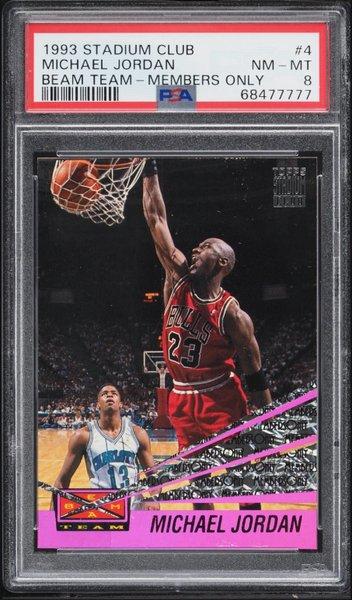
- Card: 1993 Stadium Club Beam Team Members Only Michael Jordan #4, PSA 8
- Sales: $1,300 and $1,442 in July 2026, $1,980 twice in late August, $1,000 on Nov 16
- Problem: the $1,000 listing's title leaves out "Members Only," the version this card is
With five sales since July, any one of them swings the picture. The two $1,980 sales and the $1,000 sale are both far from the July prices, and the $1,000 sale may not even be this version. A careful comp here is a range, roughly $1,300 to $1,450 from the July sales, held loosely until the card sells again.
Step 4: Take the Middle and Check the Trend
Use the median (the middle sale), not the average. One unusual sale moves an average a lot and a median very little. Then look at the order of the sales: if the newest ones are running below the older ones, the market is moving down and the median of all of them is too high, and the reverse when they are rising.
Example: A Median Is Only a Starting Point
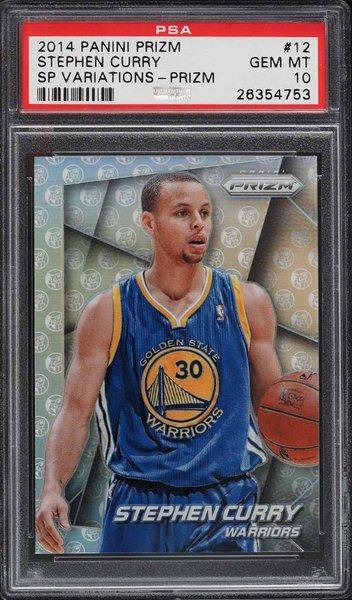
- Card: 2014 Panini Prizm SP Variations Stephen Curry #12, PSA 10
- Last six sales: $1,470 (Sept. 20, auction), $1,470 (Sept. 25, fixed price), $1,325 (Sept. 25, auction), $1,229 (Oct. 1, auction), $1,230 (Oct. 25, auction), $1,320 (Nov. 5, accepted Best Offer)
- Median: $1,323. Average: $1,341.
The two $1,470 sales came in September. The three since October ran $1,229 to $1,320, so a fair comp in November is closer to $1,230 to $1,320 than the six-sale median suggests.
Step 5: Adjust for Where You'll Buy or Sell
- Sale type. Auctions, fixed-price sales and accepted Best Offers can land at different prices for the same card in the same week. If you plan to sell at auction, auction comps are the closest match.
- Buyer's premium. Auction houses add a buyer's premium to the hammer price; at the Fanatics Premier Auction it is 20%. Check whether a recorded price includes it before comparing it with an eBay sale.
- Fees and shipping. What a seller nets is the sale price minus marketplace fees and shipping. A comp is what the buyer paid, not what the seller kept.
Where to Find Sold Prices
For a fuller comparison of these and other tools, see what collectors use to comp cards.
- eBay sold listings. Search the card, then filter by Sold Items. eBay shows about the last 90 days. For accepted Best Offers it shows the original asking price crossed out, not the price actually paid.
- 130point. Free; looks up sold eBay listings and shows the accepted Best Offer price for most of them.
- eBay Product Research (formerly Terapeak). In eBay's Seller Hub, free for sellers, with up to three years of eBay sales.
- Card Ladder. A paid service that combines sales from eBay, Fanatics and other marketplaces, including accepted Best Offer prices. Its values are one sale adjusted by an index; see how Card Ladder values a card before relying on them.
- PSA Auction Prices Realized. Free on PSA's site for PSA-graded cards.
Sources
- Product research (formerly Terapeak), eBay
- How to find sold prices on eBay, Flowlister (90-day sold history; Best Offer prices hidden; 130point)
- How Card Ladder values a card, the Card Calculus²
- Card examples: sales as recorded on Card Ladder through November 21, 2026. Slabs from the author's collection; cert numbers link to PSA's verification pages.
- PSA vs BGS vs SGC vs CGC: What Each Slab Is Worth
- PSA 10 vs PSA 9: How Much Is a PSA 9 Worth?
- BGS 9.5 vs PSA 10: Is a BGS 9.5 Worth as Much?
- SGC 10 vs PSA 10: What an SGC 10 Sells For
- CGC 10 vs PSA 10: How Much Less a CGC 10 Sells For
- BGS 10 vs PSA 10: Pristine, Black Label and Why Prices Are Hard to Pin Down
- How Card Ladder Values a Card
- Not All 10s Are Equal: Black Label, Pristine and Gem Mint 10s Explained
- What Do Collectors Use to Comp Cards? 9 Comp Tools Compared
- How Fanatics Collect Works